Our Location
308, 3rd Floor, Eros City Square Mall, Rosewood City Rd, Sector 49, Gurugram, Haryana 122018

308, 3rd Floor, Eros City Square Mall, Rosewood City Rd, Sector 49, Gurugram, Haryana 122018
Introduction
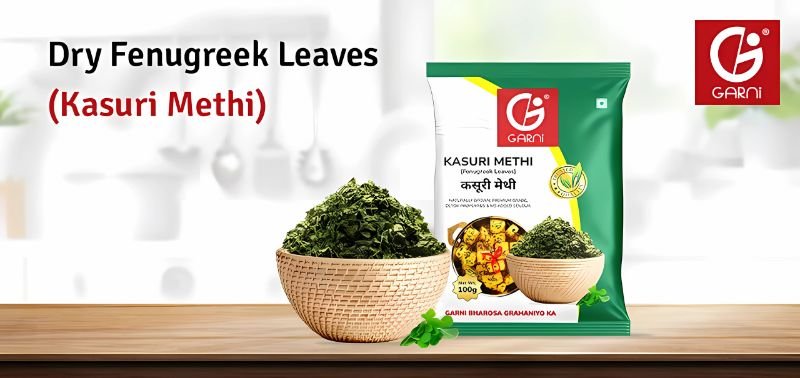
Dried fenugreek leaves, aka Kasuri Methi, is obtained from drying leaves obtained from the fenugreek plant belonging to the legume family.
Kasuri Methi is famed for possessing a powerful aroma and a bitter taste.
Methi and Kasuri Methi have a few small differences in nutritional value. Because of it having underwent a drying process, Kasuri Methi has 83-85% less Vitamin C compared to Methi.
Another main difference between Methi and Kasuri Methi is in the aroma and taste. Kasuri Methi contains a stronger aroma and taste. Most people prefer it in cooking, as well. Moreover, one can store Kasuri Methi for a long time. On the other hand, fresh Methi gets spoiled quickly.
Kasuri Methi is widely grown in the Kasur region of Punjab, hence its name.
Production and cultivation
India is the largest producer of Kasuri Methi in the World. D
Rajasthan, Madhya Pradesh, Gujarat, Haryana, West Bengal, and Uttaranchal are the major fenugreek producing states of India. Rajasthan has the most area and production dedicated to growing fenugreek, accounting for more than 37% and 33% of India’s total area and production, respectively.
The productivity level of the fenugreek crop in the country is 1566 kg/ha (2019-20).
Fenugreek leaves of two types are extensively cultivated in India: the commonly used, larger variety, has dark green, oval-shaped, and mildly bitter leaves, whereas the smaller variety has white roots and small green leaves, which is more prevalent in South India and known as menthya, vendhaya keerai, etc.
Processing of Fenugreek Leaves
Freezing
Fresh fenugreek leaves are first blanched in water at 80°C. Steam and water is then added with three chemicals: potassium metabisulphite (0.5%), magnesium oxide (0.1%) and sodium bicarbonate(0.1%), to inactivate enzymes such as lipoxygenases (LO), peroxidases (PO), and polyphenol oxidases (PPO). These enzymes cause degradation in colour, flavour, texture, and nutritional value. It also kills vegetative microbial cells and decreases any pesticide residue.The blanched fenugreek is cooled and usually packaged before freezing. However, individual quick freezing of unpackaged fenugreek can also be done followed by packaging.
Drying
The fenugreek is trimmed and sorted carefully to remove roots, older, yellowed or decayed leaves before washing.
The leaves are dried at 80°C until the moisture content drops to below 6.5%.
There are two common ways of drying fenugreek:
CABINET DRYING – At 40 °C and 50 °C respectively, at 1.1 m/s air velocity in a cabinet dryer for 6hr OR at 60°C for 4hrs.
SUN DRYING – It will take 2-3 days of strong sunlight to dry the leaves
Other names of Dry Fenugreek Leaves
Botanical Name: Trigonella Foenum-graecum
Tamil Name: Ularnta ventayam ilaikaḷ (உலர்ந்த வெந்தயம் இலைகள்)
English Name: Dried Fenugreek Leaves
Malayalam Name: Uluva ila
Hindi Name: Kasuri Methi, Kasoori Methi
Telugu Name: Mentikoora
Kannada Name: Menthya Soppu
Bengali Name: Methi Pata
Marathi Name: Vāḷalēlyā mēthīcī pānē (वाळलेल्या मेथीची पाने)
Marathi Name: Giloya
Gujarati Name: Sūkā mēthī nā pāna (સૂકા મેથી ના પાન)
Properties of Dry Fenugreek Leaves
Kasuri Methi has some medicinal properties, such as:
High antioxidant properties
Anti-diabetic effects
Reduces cholesterol levels
Anti-fungal properties
Anti-carcinogenic compounds
Anti-bacterial properties
Health benefits
Weight Loss
High in Antioxidants
Prevents Gastric Disorders
Helps Control Cholesterol
Beneficial for Diabetes
Prevents Clotting Disorders
Skin and Hair Health
Anti-Cancer Properties
Improves Kidney Function
Protects Liver
Anti-microbial Activity
Bone Health
Ensures Female Reproductive health
Improves Male Fertility
Supports Lactation
Side effects of Dry Fenugreek Leaves
Allergy – Fenugreek may trigger an allergic reaction in some sporadic cases.
Inflammatory Bowel Disease – When taken in excess, it may cause symptoms including abdominal pain, cramps, diarrhea, headache, dizziness, etc.
Pregnancy – Fenugreek leaves cause pre-term childbirth or miscarriage. Therefore, it is advisable to consult a physician before including fenugreek leaves.
Diabetes – Fenugreek reduces blood sugar levels. However, if you are on any diabetes medication, it may cause fluctuations in your blood glucose levels. Therefore, consult your doctor before including fenugreek in your diet.
Nutrional value (100g) (3.5 oz)
Energy 1,352 KJ (323 kcal)
Carbohydrates 58 g
Dietary fibre 25 g
Fat 6.4 g
Protein 23 g
Vitamin Quantity – Thiamine (B1) (0.322 mg) 28%, Riboflavin (B2) (0.366 mg) 31%, Niacin (B3) (1.64 mg) 11%, Vitamin B6 (0.6 mg) 46%, Vitamin C (3 mg) 4%
Chlorophyll (0.70 mg/100g)
Ascorbic acid (0.54 mg/100g)
Calcium (360 mg/100g),
Iron (17.2 mg/100g)
Green leafy vegetables conform to the following analytical standards
Parameter
Moisture content (on dry basis) m/m
Sulphur Dioxide
Peroxidase test
Ash insoluble in dilute HCI
Lead content (metel content )
FSSAI Standard
Not more than 7.0 percent
Not more than 2000 ppm
Should be negative
Not more than 0.5 percent
Not more than 5.00 Parts per Million (mg/kg or mg/L)
Storage condition
Use an air-tight container to store dried fenugreek leaves.
Keep the container in a cool and dry place.
Keep it away from moisture.
Keep it away from UV rays and direct sunlight.
Store in a refrigerator for extended shelf life.
Garni Kasuri Methi
Available in 25g, 50g ,100g and 500g Packaging
THANK YOU FOR READING !
By Dhwani Verma